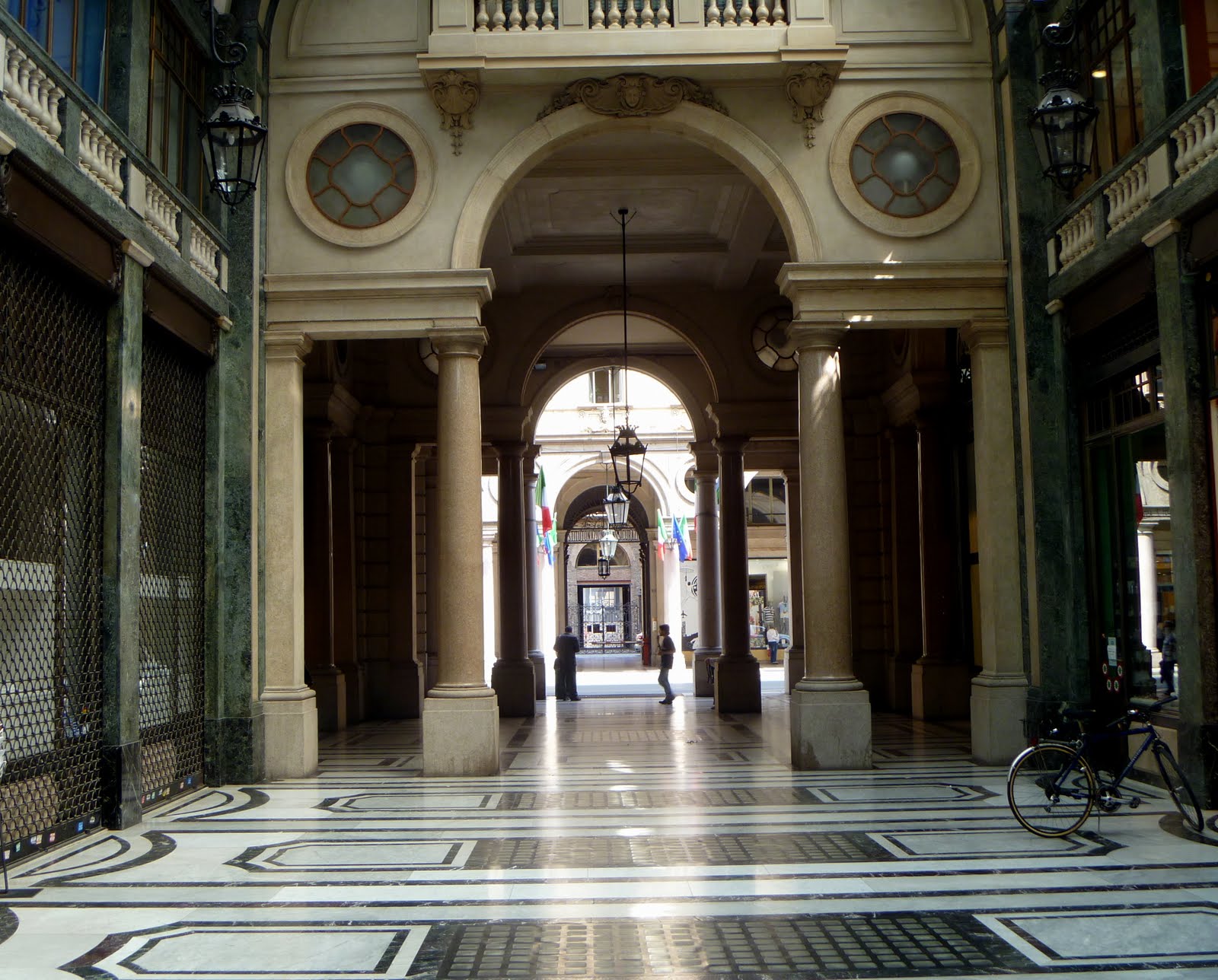
Turin (that is, Torino) is new for us. It is a beautiful city, with wide streets and porticos to protect from sun and rain.
We visited the museum of the Palazzo Madama for some of our favorite types of exhibits, specifically, lace, ceramics, and glass.
We are staying at a small, modest, one-star hotel in a four-star location, Piazza San Carlo. The piazza at night looks like this:
The next post will be about the food of Torino. Hope you are hungry.
Wednesday, June 15, 2011
Tuesday, June 14, 2011
Visit with Friends
When we lived in Bologna for five months in 1997, we became friends with a young man named Valerio and his parents, Daniela and Franco. Valerio now works in nearby Ferrara, and we met him, his parents, and family friend Giliola for a Ferrarese dinner. Our conversation, in Italian and English more or less, covered family updates and news of the day.
The dinner, for you foodies, included cappelacci di zucca, pasta stuffed with squash and (some say) shaped like a Capuchin monk's hood, hence the name. You can have them with sugo, balsamic vinegar, or butter and sage.
Sugo, another Ferrara specialty. It is pork sausage cooked in a pig's bladder. Not sure what they do it it but it ends up very, very rich, with a texture like meatloaf. Some of our party had sugo with potatoes (the potatoes cut the richness); the rest of us had a beautiful branzino, a European sea bass.
Sorry, no photos, but you can do your own Google search.
After dinner, we went to Daniela's art studio, where she teaches and works.
On Sunday, we walked through the antique market around Santo Stefano, a church made up of seven smaller churches from various times. Many treasures and "treasures" for sale, including postcards from Seattle and Bend, if you look closely in the center.
The dinner, for you foodies, included cappelacci di zucca, pasta stuffed with squash and (some say) shaped like a Capuchin monk's hood, hence the name. You can have them with sugo, balsamic vinegar, or butter and sage.
Sugo, another Ferrara specialty. It is pork sausage cooked in a pig's bladder. Not sure what they do it it but it ends up very, very rich, with a texture like meatloaf. Some of our party had sugo with potatoes (the potatoes cut the richness); the rest of us had a beautiful branzino, a European sea bass.
Sorry, no photos, but you can do your own Google search.
After dinner, we went to Daniela's art studio, where she teaches and works.
On Sunday, we walked through the antique market around Santo Stefano, a church made up of seven smaller churches from various times. Many treasures and "treasures" for sale, including postcards from Seattle and Bend, if you look closely in the center.
Saturday, June 11, 2011
A Few Plates
Most people know that Bologna is famous for its food. See for yourself.
Tris, or three pastas on a plate. In this case the pastas are tagliatelle with ragú, tortellini in cream sauce, and tortoloni in fresh tomato sauce.
Lasagna bolognese, the classic with spinach pasta, ragú, and bechamel sauce.
A selection of meat and cheese from Tamburini, with a dollop of aged balsamic vinegar, enjoyed with Pignoletto Frizzante, the perfect local wine.
Tris, or three pastas on a plate. In this case the pastas are tagliatelle with ragú, tortellini in cream sauce, and tortoloni in fresh tomato sauce.
Lasagna bolognese, the classic with spinach pasta, ragú, and bechamel sauce.
A selection of meat and cheese from Tamburini, with a dollop of aged balsamic vinegar, enjoyed with Pignoletto Frizzante, the perfect local wine.
Thursday, June 09, 2011
Glass
As members of Tacoma's Museum of Glass, we have learned a little about glass over the years. We visited one of our favorite museums in Bologna, Davia Bargellini, and found glass. This is Venetian glass from the 1500s, 1600s, and 1900s. I have seen some of the same elements in glass by contemporary masters.
You will not be surprised that Sue went yarn shopping. Details on her knitting blog.
We will not bore you with the details of the wonderful Bologna cuisine. Let's just say it is excellent. And Italians really know their ice cream.
You will not be surprised that Sue went yarn shopping. Details on her knitting blog.
We will not bore you with the details of the wonderful Bologna cuisine. Let's just say it is excellent. And Italians really know their ice cream.
Wednesday, June 08, 2011
Back in Bologna
After 24 hours of travel we are back in Bologna. We have rented a tiny apartment, about the size of our cabin, in an excellent location. Tiny? This is our kitchen, the whole kitchen.
The first thing to do in Bologna is to walk through the market. Even if you are not buying, it is fun to look.
Yes, we are eating well in Bologna. The spinach, mozzarella, and ricotta pizza at lunch was especially tasty, as was the pizza with fresh porcini mushrooms last night.
The first thing to do in Bologna is to walk through the market. Even if you are not buying, it is fun to look.
Yes, we are eating well in Bologna. The spinach, mozzarella, and ricotta pizza at lunch was especially tasty, as was the pizza with fresh porcini mushrooms last night.
Tuesday, March 15, 2011
Gooooooooool!
We couldn't go to Argentina without going to a soccer game. We might have been able to go to a game of one of the "big" teams — River Plate or Boca Juniors — but we chose instead to go to a game in Mendoza, Godoy Cruz v. San Lorenzo. Alas, San Lorenzo, the visitors from Buenos Aires, won, 2-0, against the Godoy Cruz home team. Nevertheless, the evening was fun and the spectacle was — well, spectacular.
A couple of things stood out. One was that the cost of our tickets was 100 pesos for the men and 50 pesos for the women.
Another was security. Everyone was subject to a police pat-down as they entered. Police were everywhere — and very visible — inside and outside the stadium. Whether because of or in spite of the heavy police presence, the crowd was well-behaved in their exuberance and enthusiasm.
We were sitting in the stands under cover, avoiding the end zone — the curva — where the more rabid fans congregate.
Apparently the security check does not exclude fireworks and smoke, which greeted the home team.
The coolest thing was the giant banner that the fans unfurled. It was spread out with clockwork precision from the top of the curve to the bottom. Then it was rolled up to the top for use at the next game.
Once again, thanks to Scott Hogman for the great photos.
Mike did not want to select a shirt for a particular team so bought a shirt for the Argentina national team.
A couple of things stood out. One was that the cost of our tickets was 100 pesos for the men and 50 pesos for the women.
Another was security. Everyone was subject to a police pat-down as they entered. Police were everywhere — and very visible — inside and outside the stadium. Whether because of or in spite of the heavy police presence, the crowd was well-behaved in their exuberance and enthusiasm.
We were sitting in the stands under cover, avoiding the end zone — the curva — where the more rabid fans congregate.
Apparently the security check does not exclude fireworks and smoke, which greeted the home team.
The coolest thing was the giant banner that the fans unfurled. It was spread out with clockwork precision from the top of the curve to the bottom. Then it was rolled up to the top for use at the next game.
Once again, thanks to Scott Hogman for the great photos.
Mike did not want to select a shirt for a particular team so bought a shirt for the Argentina national team.
Monday, March 14, 2011
Saturday, March 12, 2011
Dumb, Dumb, Dumb
Sometimes when you are traveling, you do things that, in retrospect, were really dumb. We had one such adventure in Mendoza. Instead of calling it Really Dumb Thing That We Did, we now refer to it as Our Adventure.
We were traveling from Mendoza to Tupungato in the Uco Valley to visit a winery. We asked our driver, Gerardo, about taking a scenic back route in the Andes foothills from Mendoza to Potrerillos, then on Route 89 from Potrerillos to Tupungato. After a few phone calls, Gerardo told us that this was a dirt road but do-able. (Side note: hiring a car and driver in Mendoza was one of the smart things we did, and Gerardo was an excellent driver.)
What we didn't know was that it had rained the previous night and that the dirt road was a mud road. Had we been sensible or thought things through, we should have/would have/could have turned around at the first mud crossing. But we didn't. And Gerardo said we could go forward.
At several points, all four of us American-sized passengers had to get out of the little car and ford the mud so the car could get enough clearance to drive through.
As we crossed the mountain, all we saw was fog. Fog on a muddy, rutted, one-and-a-half-lane mountain road.
We were glad to see the road crews out moving mud.
Just when we thought we might make it through the mud, we feared being run down by horses. At one point we rounded a corner and saw a dozen or so horses headed for us, as a man and his dogs were herding them from one pasture to another.
When we arrived safely in Tupungato, we discovered the winery we planned to visit was closed because the rain had washed out its road. We ended up having lunch in a fabulous restaurant in Tupungato called El Ilo. Later we learned it specialized in fish, which we generally didn't order, but the food was excellent anyway.
And we took the main highway back to Mendoza.
Many thanks to ace photographer Scott Hogman for the photos. He had the presence of mind to take pictures from the front seat while the three of us sitting tightly in the back seat worried about Gerardo's car and out ability to get out of this adventure.
We were traveling from Mendoza to Tupungato in the Uco Valley to visit a winery. We asked our driver, Gerardo, about taking a scenic back route in the Andes foothills from Mendoza to Potrerillos, then on Route 89 from Potrerillos to Tupungato. After a few phone calls, Gerardo told us that this was a dirt road but do-able. (Side note: hiring a car and driver in Mendoza was one of the smart things we did, and Gerardo was an excellent driver.)
What we didn't know was that it had rained the previous night and that the dirt road was a mud road. Had we been sensible or thought things through, we should have/would have/could have turned around at the first mud crossing. But we didn't. And Gerardo said we could go forward.
At several points, all four of us American-sized passengers had to get out of the little car and ford the mud so the car could get enough clearance to drive through.
As we crossed the mountain, all we saw was fog. Fog on a muddy, rutted, one-and-a-half-lane mountain road.
We were glad to see the road crews out moving mud.
Just when we thought we might make it through the mud, we feared being run down by horses. At one point we rounded a corner and saw a dozen or so horses headed for us, as a man and his dogs were herding them from one pasture to another.
When we arrived safely in Tupungato, we discovered the winery we planned to visit was closed because the rain had washed out its road. We ended up having lunch in a fabulous restaurant in Tupungato called El Ilo. Later we learned it specialized in fish, which we generally didn't order, but the food was excellent anyway.
And we took the main highway back to Mendoza.
Many thanks to ace photographer Scott Hogman for the photos. He had the presence of mind to take pictures from the front seat while the three of us sitting tightly in the back seat worried about Gerardo's car and out ability to get out of this adventure.
Friday, March 11, 2011
Golf Sauce
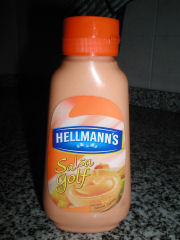
Among the condiments we found on restaurant tables in Argentina was Golf Sauce. We couldn't tell from the small packets exactly what Golf Sauce was. Nor could we tell from the color, sort of a pinkish-orange.
We learned that Golf Sauce was invented by Luis Federico Leloir, Argentinian Nobel laureate in chemistry. The story is that in the mid-1920s, Leloir was at the golf club in Mar del Plata. He wanted a sauce for his shrimp, and asked the waiter to bring a variety of ingredients. He mixed a little of this, a little of that to end up with Golf Sauce, or Salsa Golf.
Argentinians use Golf Sauce on all sorts of meats, salads, and sandwiches.
So what magic combination did Leloir find for Golf Sauce? Mayonnaise and ketchup. Yes, mayonnaise and ketchup. Some people may add other ingredients, but basic Golf Sauce is mayonnaise and ketchup.
We learned that Golf Sauce was invented by Luis Federico Leloir, Argentinian Nobel laureate in chemistry. The story is that in the mid-1920s, Leloir was at the golf club in Mar del Plata. He wanted a sauce for his shrimp, and asked the waiter to bring a variety of ingredients. He mixed a little of this, a little of that to end up with Golf Sauce, or Salsa Golf.
Argentinians use Golf Sauce on all sorts of meats, salads, and sandwiches.
So what magic combination did Leloir find for Golf Sauce? Mayonnaise and ketchup. Yes, mayonnaise and ketchup. Some people may add other ingredients, but basic Golf Sauce is mayonnaise and ketchup.
Monday, March 07, 2011
Alfajores — Yum!
Didn't know what an alfajor was before going to Argentina and now I do. And I am glad that I know.
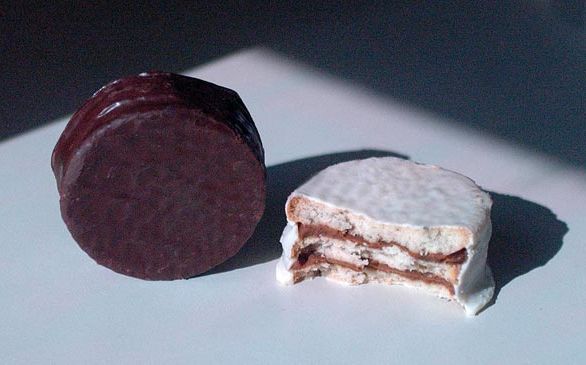
Alfajores are a cookie-cake confection that includes two or more layers of cookie, filling, and a covering. The cookies can be plain or chocolate. The filling can be dulce de leche or jam. The covering can be chocolate, white chocolate, powdered sugar, or meringue. Some come with nuts or coconut. Whatever combination, they are great. They are tasty and satisfying but not overly sweet or gooey.
We especially like the alfajores from Havanna Café. We first tasted Havanna alfajores on our LAN Argentina flight from Buenos Aires to Mendoza. And we definitely had to have more. Luckily for us, Havanna Cafés are all over Buenos Aires.
If you want to make your own alfajores — and why wouldn't you? — look here.
Alfajores are a cookie-cake confection that includes two or more layers of cookie, filling, and a covering. The cookies can be plain or chocolate. The filling can be dulce de leche or jam. The covering can be chocolate, white chocolate, powdered sugar, or meringue. Some come with nuts or coconut. Whatever combination, they are great. They are tasty and satisfying but not overly sweet or gooey.
If you want to make your own alfajores — and why wouldn't you? — look here.
Sunday, March 06, 2011
River Tour
A trip to Tigre, north of Buenos Aires on the river, is recommended in most of the tourist guides, so we signed on for a tour, not quite knowing what to expect. We were delighted with the result.
We started on a small bus, the four people in our group plus a couple from England, with a driver and guide. We drove through some of the lovely Buenos Aires suburbs, including Olivos, where the presidential residence is; San Fernando; San Isidro; and, finally, Tigre. We would not have seen these areas of Buenos Aires without this tour.
Two notable things about the river, Rio de la Plata, is that it is very brown and very wide. Milk chocolate brown. Caffé latte brown.
The Tigre market was not open during the week, but we drove around it and saw the many furniture shops that are the signature of the market. We took a boat ride on the brown river from Tigre through a small part of the delta to Puerto Madero in Buenos Aires.
The Rio de la Plata delta includes scores, maybe hundreds, of small islands. People build houses on the islands on stilts to avoid periodic flooding. The houses are named and numbered. If you want to send a letter to one of these houses, you address it to the river name, house name, and house number. Travel through the delta is by boat, no roads. You can have groceries delivered by boat and garbage picked up by boat.
We started on a small bus, the four people in our group plus a couple from England, with a driver and guide. We drove through some of the lovely Buenos Aires suburbs, including Olivos, where the presidential residence is; San Fernando; San Isidro; and, finally, Tigre. We would not have seen these areas of Buenos Aires without this tour.
Two notable things about the river, Rio de la Plata, is that it is very brown and very wide. Milk chocolate brown. Caffé latte brown.
The Tigre market was not open during the week, but we drove around it and saw the many furniture shops that are the signature of the market. We took a boat ride on the brown river from Tigre through a small part of the delta to Puerto Madero in Buenos Aires.
The Rio de la Plata delta includes scores, maybe hundreds, of small islands. People build houses on the islands on stilts to avoid periodic flooding. The houses are named and numbered. If you want to send a letter to one of these houses, you address it to the river name, house name, and house number. Travel through the delta is by boat, no roads. You can have groceries delivered by boat and garbage picked up by boat.
Saturday, March 05, 2011
Winemakers
One of many great pleasures of our trip to Argentina was visiting with winemakers. Tasting their wines was, of course, great fun, but more interesting was meeting the winemakers and winery owners to learn their views on the wine industry in Argentina and how each particular winemaker sees his or her place in that industry.
Anabelle Sielecki is an amazing woman: architect, real estate executive, and co-owner of Mendel. We spoke with winemaker/co-owner Roberto de la Mota in Mendoza and had a chance to meet with Anabelle in Buenos Aires at the cafe outside of the MALBA museum.
We also met with Guillermo Banfi, owner of Bodega Sur de los Andes. During a fabulous lunch at Don Julio, we tasted Guillermo's excellent wines, which paired well with the sausage, provoleta, beef steaks, arugula salad, and tomatoes. Like Anabelle (and other winery owners) Guillermo entered the wine business after another career, finance, in his case.
Anabelle Sielecki is an amazing woman: architect, real estate executive, and co-owner of Mendel. We spoke with winemaker/co-owner Roberto de la Mota in Mendoza and had a chance to meet with Anabelle in Buenos Aires at the cafe outside of the MALBA museum.
We also met with Guillermo Banfi, owner of Bodega Sur de los Andes. During a fabulous lunch at Don Julio, we tasted Guillermo's excellent wines, which paired well with the sausage, provoleta, beef steaks, arugula salad, and tomatoes. Like Anabelle (and other winery owners) Guillermo entered the wine business after another career, finance, in his case.
Note: we are actually back at home now but we have several more Argentina experiences to share, which we will do here. So stay tuned. And, we will be traveling to Italy later this year and will share those experiences here also.
Wednesday, March 02, 2011
Estancia Day
We are tourists. We know we are tourists. That's why we signed on for a tourist visit to an estancia, La Cinacina. A friend recommended La Cinacina as a place where visitors enjoy an afternoon of tourist-oriented gaucho culture at a reasonable price. And that's exactly what we experienced.
La Cinacina is in San Antonio de Areco, a small town that is about a 90-minute bus ride from Buenos Aires (the trip took us by Estadio Monumental, home of River Plate soccer team, a team that it seems most Argentinians love or hate, but that's another story).
At the ranch, we were greeted with wine and empanadas, then had the opportunity for a brief horseback ride. No, no photos of us on horses. Then it was back to the ranch house for more food, including sausages, beef, and pork, salads, potatoes, and more wine. Our Venezuelan table-mate shared with the dog, who has seen tourists before.
Dinner was followed by a show of music and dance from around Argentina.
The host of the show then ran a list of the countries represented at our visit: Argentina, United States, Venezuela, Uruguay, Switzerland, Puerto Rico, Russia, Germany, Italy, Canada, and a few more.
Then we saw the gaucho show where expert horsemen demonstrated gaucho skills, such as riding down the track at full speed and putting a pencil-sized stick through a small ring hanging from a rope. The story is that if the gaucho captures the ring, he can give it to the woman of his choice; if she accepts the ring, she gives him a kiss but if she rejects the ring, she kisses the horse.
We finished the day with quince pastries and mate, an herbal tea that Argentinians seem to love. The pastries were great but mate may be an acquired taste.
All in all, a good day to be a tourist.
La Cinacina is in San Antonio de Areco, a small town that is about a 90-minute bus ride from Buenos Aires (the trip took us by Estadio Monumental, home of River Plate soccer team, a team that it seems most Argentinians love or hate, but that's another story).
At the ranch, we were greeted with wine and empanadas, then had the opportunity for a brief horseback ride. No, no photos of us on horses. Then it was back to the ranch house for more food, including sausages, beef, and pork, salads, potatoes, and more wine. Our Venezuelan table-mate shared with the dog, who has seen tourists before.
Dinner was followed by a show of music and dance from around Argentina.
The host of the show then ran a list of the countries represented at our visit: Argentina, United States, Venezuela, Uruguay, Switzerland, Puerto Rico, Russia, Germany, Italy, Canada, and a few more.
Then we saw the gaucho show where expert horsemen demonstrated gaucho skills, such as riding down the track at full speed and putting a pencil-sized stick through a small ring hanging from a rope. The story is that if the gaucho captures the ring, he can give it to the woman of his choice; if she accepts the ring, she gives him a kiss but if she rejects the ring, she kisses the horse.
We finished the day with quince pastries and mate, an herbal tea that Argentinians seem to love. The pastries were great but mate may be an acquired taste.
All in all, a good day to be a tourist.
Subscribe to:
Posts (Atom)